
Products
Bellows
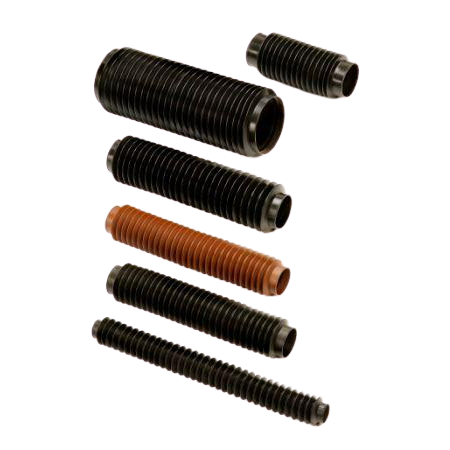
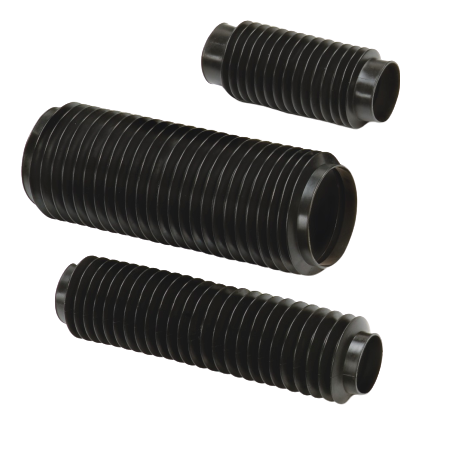
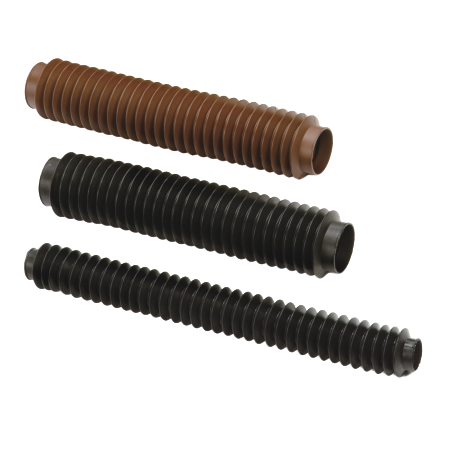
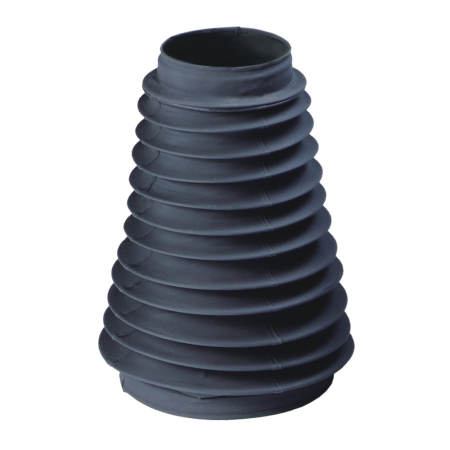
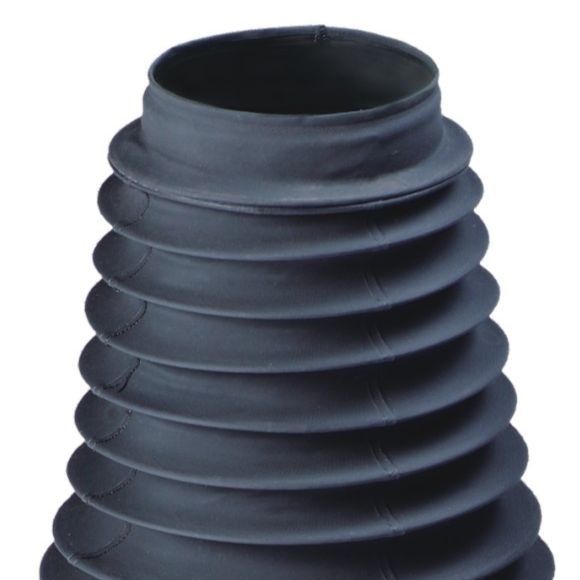
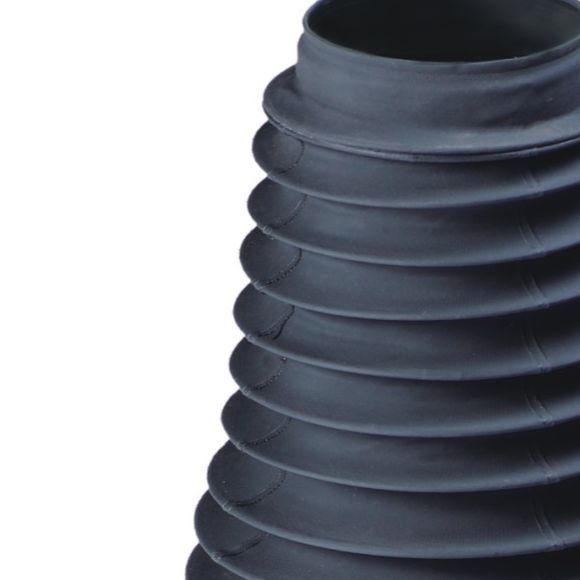
Round rubber bellow
- The circular round rubber bellow (rubber dust boot) is used to protect axial transmission components such as screws, hydraulic cylinders, and pneumatic cylinders to prevent the intrusion of oil, water, and dust. We provide standard size comparison tables and customized services. The materials comply with RoHS regulations and can be selected according to oil resistance, heat resistance, and waterproof requirements. Fast delivery.
- What is a Round Rubber Bellows?
- The round rubber bellow (also known as rubber dust jacket, circular corrugated sheath) is a telescopic protective part installed on the outside of axial transmission components such as screws, hydraulic cylinders, and pneumatic cylinders. Its main function is to prevent oil, water, and dust from entering the transmission core when the equipment is operating and axially telescopic. This prevents components from wearing, reducing accuracy, or premature failure due to foreign matter intrusion. In addition to general drive shaft protection, circular telescopic sheaths are also commonly used in electrical discharge machine (EDM) fluid level control systems, as well as in extra-long screw applications that require long-stroke protection.
- For factory equipment maintenance and machine design engineers, choosing the right material and size of the dust cover can directly extend the life of the equipment and reduce downtime maintenance costs - this is the core value of the circular telescopic sheath.
- Why does equipment need round rubber bellow?
- When industrial equipment is operated for a long time, the life and accuracy of screws and hydraulic/pneumatic cylinders are easily affected by the following problems:
- 1. Dust and debris intrusion: Dust and chips generated during the machining process adhere to exposed shaft parts and wear the threads or cylinder surface for a long time.
- 2. Oil and water penetrate into the transmission components: causing lubrication failure, rust or component sticking.
- 3. Environmental corrosion: There are weak acid and alkali liquids in some industrial environments, and the general sheath material is prone to premature aging.
- The round rubber bellow through the entire length of the axial transmission element through a rubber elastic telescopic structure. It expands and contracts synchronously with the equipment stroke. It is also oil-resistant, heat-resistant, waterproof, dust-proof, and weak acid and alkali resistant. It blocks foreign matter and liquid from contacting the transmission core from the source. It is one of the most commonly used axial protection solutions in the industry.
- Quick Selection: Standardized Size Comparison Table
- To meet customers' needs for rapid delivery, we have established a standardized specification comparison table for circular telescopic sleeves, covering the following selection items:
- Selection Item | Description
- End Flange Type | Multiple flange configurations are available depending on the installation end structure
- Clamping Joint Selection | Choose between clamping ring or clamping joint type based on the on-site locking method
- Inner Diameter / Outer Diameter | Standard inner and outer diameter range corresponding to the size of the transmission components
- Extension / Compression Dimensions | Corresponding telescopic ratio is provided based on equipment stroke requirements
- If the standard listed dimensions do not meet on-site requirements, customized services are also available (see customization instructions below).
- Materials and Structure: How to Choose the Right Round Rubber Bellow for Your Environment
- The durability of circular telescopic sleeves hinges on whether the material is suitable for the actual operating environment. We offer a selection of appropriate rubber materials based on the environment of our customer's equipment (oil contact, high temperature, humidity, dust, acid and alkaline gases, etc.), and use suitable materials for both the front and rear structures:
- 1. Main body rubber material: Graded according to requirements for oil resistance, heat resistance, water resistance, dust resistance, and resistance to weak acids and alkalis.
- 2. Front and rear flanges/locking rings: Typically made of metal to ensure locking strength and long-term stability.
- 3. Customized internal structure: Special structures such as support plate, support tube, and ventilation holes can be added according to customer needs to meet specific venting, drainage, or sensing requirements.
- Common materials comply with EU RoHS standards, making them suitable for industries and export equipment with environmental regulations.
- The core advantages of round rubber bellow
- 1. Possesses multiple protective properties including oil resistance, heat resistance, water resistance, dust resistance, and resistance to weak acids and alkalis, extending equipment lifespan.
- 2. Suitable for the protection of various axial transmission components such as screws, hydraulic cylinders, and pneumatic cylinders, with a wide range of applications.
- 3. Can provide selection or customization solutions according to customer requirements for inner and outer diameter dimensions, elongation and compression dimensions, and operating environment conditions to meet non-standard specification needs.
- Application fields
- Circular telescopic sleeves are widely used in hydraulic equipment, injection molding machines, and other mold forming machines. Installed on the outside of the screw or cylinder, they effectively prevent dust, oil, and water from entering the transmission core, avoiding degradation of equipment precision and shortened lifespan. They are a common protective component in the mold forming industry for improving equipment uptime and reducing maintenance costs.
- Common applications include:
- 1. Plastic injection molding machines (screw protection)
- 2. Hydraulic presses and hydraulic cylinder systems
- 3. Pneumatic transmission equipment
- 4. Electrical discharge machining (EDM) fluid level control systems
- 5. Precision screw equipment requiring protection for ultra-long strokes
- Why choose us?
- 1. Practical experience in environmentally customized material selection: We recommend appropriate rubber materials based on the customer's actual operating environment (oil type, temperature range, acid/alkali concentration, etc.), rather than simply providing a single specification product.
- 2. Standardization + customization in parallel: Standard comparison tables ensure fast delivery of in-stock items, while retaining customization flexibility for inner and outer diameters, expansion joints, and internal structures (branch pipes, airtight holes).
- 3. Material compliance: Commonly used materials comply with EU RoHS regulations, suitable for use in industries with environmental regulations and export equipment.
- FAQ Frequently Asked Questions
- Q1: What is the main function of a circular telescopic sleeve? The main function of a circular telescopic sleeve is to prevent oil, water, and dust from entering the transmission core of axial transmission components (such as screws, hydraulic cylinders, and pneumatic cylinders) during operation, avoiding component wear and precision degradation, and extending equipment lifespan.
- Q2: What is the difference between a circular telescopic sleeve and a regular dust cover?
- A circular telescopic sleeve uses a rubber elastic telescopic structure, which can extend and compress synchronously with the equipment stroke. It also possesses multiple properties such as oil resistance, heat resistance, water resistance, dust resistance, and resistance to weak acids and alkalis, making it more suitable for long-stroke, high-frequency axial transmission applications compared to a regular fixed dust cover.
- Q3: Can circular telescopic sleeves be customized in size?
- Yes. In addition to the standard size chart (covering flange type, flange opening, inner and outer diameters, and telescopic dimensions), we also provide customized services based on the customer's actual inner and outer diameters, telescopic stroke, and operating environment conditions, including adding support tubes, support plate, ventilation holes, and other special structures.
- Q4: Does the material of the circular telescopic sleeve comply with environmental regulations?
- Yes. Our commonly used rubber materials all comply with EU RoHS standards, making them suitable for industries and export equipment with environmental regulations.
- Q5: What equipment is a circular telescopic sleeve suitable for?
- Circular telescopic sleeves are suitable for hydraulic equipment, injection molding equipment, and other mold forming machines, as well as for EDM (Electrical Discharge Machining) fluid level control systems and ultra-long-distance screw protection applications. They are primarily used to protect axial transmission components from oil, water, and dust intrusion.
- Q6: How to choose the appropriate circular telescopic sleeve material?
- Before selecting a material, it is necessary to confirm the equipment's operating environment conditions, such as whether it comes into contact with oil, high temperatures, humidity, dust, or weak acid/alkali liquids. We will recommend corresponding rubber materials that are oil-resistant, heat-resistant, waterproof, dustproof, or resistant to weak acids and alkalis based on the customer's actual operating environment. Front and rear flanges or retaining rings are mostly made of metal to ensure locking stability.
- Q7: How to customize the round bellow without disassembling the machine?
- We can choose a split zipper design, in order to easy disassembly & assembly, also it can reduce the machine down time during the installation or disassembly process.
Round rubber bellow
.png)
(3).jpg)
.png)
Round Rubber Bellow Boots for Shafts, Cylinders & Spindles
A round rubber bellow is a flexible, tubular boot that slips over a cylindrical shaft, piston rod, or spindle to seal it against dust, chips, coolant, and moisture. The convoluted (folded) wall lets the round rubber bellow stretch and compress with axial movement while keeping contaminants out, protecting precision surfaces, seals, and bearings from premature wear. MEGUS manufactures these boots in a wide range of diameters and fold counts, in both moulded and fabricated constructions.
Round components such as cylinder rods, ball-screw ends, and machine spindles are easy to overlook, yet they are highly vulnerable: a single scratch or trapped abrasive can ruin a seal and lead to leaks or play. A close-fitting elastomer boot is a simple, low-cost way to keep that contamination out and avoid expensive repairs.
Construction and Materials
Each round rubber bellow is moulded or fabricated from elastomers chosen for the working environment. Nitrile (NBR) offers excellent oil and coolant resistance, neoprene (CR) balances weather and chemical resistance, and silicone or EPDM handle high temperatures and UV exposure. The convoluted profile gives a high compression-to-extension ratio, so a short collapsed boot can cover a long stroke, while flexible end collars grip the shaft or clamp securely to a housing.Moulded Versus Fabricated Boots
We make these boots two ways, and the right choice depends on size and quantity. Moulded boots are formed in a tool to give a seamless, uniform wall with crisp convolutions – ideal for smaller diameters, high volumes, and the most demanding sealing duty. Fabricated boots are built up from sheet elastomer and bonded, which is the economical route for large diameters, long strokes, and low-to-medium quantities where tooling a mould would not be justified. Both constructions deliver the same essential protection; our engineers recommend whichever gives you the best fit, durability, and price for your particular shaft and production run.Key Features
- Convoluted wall for a high stroke-to-length ratio
- Oil-, coolant-, heat-, and weather-resistant elastomers (NBR, CR, EPDM, silicone)
- Flexible end collars that grip the shaft or clamp to a housing
- Custom inner diameters, outer diameters, and free lengths
How to Specify
To match a boot exactly we need the inner diameter (the shaft it fits), the outer diameter clearance, the free and compressed lengths, the stroke, and the operating temperature and fluids. With those details our team recommends the right elastomer grade, wall thickness, and fold design. If you are replacing a worn boot, send the old part or a sample and we will reproduce it.Applications
These boots are used on hydraulic and pneumatic cylinders, machine spindles, ball-screw ends, gear shifters, steering and suspension components, and any round shaft that must move freely while staying sealed. In machine tools they protect quills, pistons, and probe shafts from swarf and coolant ingress; in mobile and automotive equipment they keep grit and water out of joints and actuators. Because the same convoluted design scales from a few millimetres to large-diameter cylinders, one supplier can cover protection needs that span an entire machine or vehicle.Installation and Maintenance
Fitting is simple: the elastic end collars stretch over the shaft and seat against a shoulder or clamp into a groove, holding the boot concentric so it flexes evenly. Where a boot must be fitted without access to the shaft end, we can supply a split-and-bonded version that wraps around the shaft in place. In service the rubber wall sheds coolant and grit and needs no routine care beyond an occasional inspection for cuts or hardening; a damaged boot is quickly swapped for a fresh one, restoring the seal before the exposed shaft can be harmed.Benefits
- Keeps abrasive dust and coolant away from seals and bearings
- Reduces maintenance and extends component service life
- Operates quietly and flexibly through long stroke cycles
- Available off-the-shelf or fully customised